Monday, March 8, 2021

Colossians 1

 The letter opens with a traditional Pauline greeting, Paul stating that he has authority from God to write this letter, and from his good friend and scribe Timothy. Paul is writing this letter to address something known as the "Colossian Heresy"; it is not an exact definition, but the Colossian Heresy is the false doctrine that was beginning to permeate the city. Christian doctrine was becoming corrupt with mysticism, Gnosticism, and Jewish legalism; in short, there was lots of mixing of Christian doctrine with other religions and Paul wasn't too keen on that idea! This letter is his attempt to straighten them out! Are there times when you'd like to "straighten them out" when it comes to God and Jesus and the Holy Spirit? Even knowing that, this letter – full of love and concern, written to a church Paul had neither planted nor visited – shows the power of Christian love. Paul didn’t need to see or meet or directly know these Christians in order to love them and be concerned for them.

Paul mentions that he prays for them; remember, Paul didn't start his church- it is likely a man known as Epaphras (v 7) started the church in Colosse. It was primarily Gentiles (some Jews) and Philemon was a member and good leader of this church. Paul continues to pour out thanksgivings and grace to the people at the church; thankful for the work they are doing; thankful for the love they exhibit to all people; thankful for their presence and ministry to the city. There is a slight change in Paul's words though in v 9; Paul begins to change and talk about hod he prays for wisdom so that they can get back on track. Do  you pray like that? Begin with positives and then change language slightly asking for petitions on behalf of someone? Throughout this epistle, you will see Paul asking for wisdom and knowledge to increase for the Colossians. Paul desires them to "produce fruit" (v 10b), a common theme in Paul's writings; we have heard that view several times previous to this. Paul ends this section with a brief commentary on darkness and the potential power it has over us, but that God, through Jesus has freed us from that. Darkness is still an intense image for the evil and wicked powers that are in our world.

Paul now turns to a brief commentary/ meditation on the importance of Jesus. Theologians have long thought that Paul "borrowed" these words (vv 15-20) from a poem or hymn from the early church that describe what the early church believed about Jesus. Can you see the somewhat poetic/ musical trend in these lines? The first words Paul uses in this section are that "Jesus is the exact copy of God..." (v 15). Paul then goes on to focus his whole mind and heart on the centrality of Jesus; you can tell that Paul's entire being is consumed by the presence and awesomeness of Jesus. I just loved this section and read it several times. It made my heart and soul feel good. What does this passage tell you about Paul? I love the closing verse (v 20b) in my translations, "God made peace..."  Where is that peace now? Paul certainly feels it!

There are some really hard words in v 21, "At one time, you were separated from God..." referring to the point that we are human and we are of Adam's lineage! As pre-Christ humans, we were born alienated to God and then we accept a relationship with that same God that we were alienated from. Now, through Jesus, God has accepted all people into God's family. God's answer/response to that alienation brought on by Adam was the life and death of Christ= reconciliation to God. Do you feel alienated from God? Paul then goes on (v 23) to tell the people to continue to have faith and hope in Jesus; as per usual- the Colossians were beginning to get pulled away from God/ Jesus by the other religions and gods that were in Colosse. Do you feel getting pulled away at times? What does that do to your hope and faith?

Paul takes another turn (vv 24- 29) and begins to talk about himself and the suffering that he is going through for the good of the church. Paul likely wrote this letter from prison, and he comments (as he has in a few other letters that we have read), "My suffering is for the good." Paul comments that as Christ suffered for the church, so we must also suffer at times for the good of the church. There are pains that we all feel-- however, there is no comparison to the sufferings and pains that Christ felt for the Church! Have you felt those pains for your church? Paul tells that he was selected by God to teach/preach about Christ; Paul didn't put himself into that position- God put Paul there. Pastors often talk about heir "calling" into ministry. I feel we are all called to some aspect of ministry in the church. Do you have a "calling" that you can remember? Are you active in that ministry now?

Paul discusses the "mystery" or "secret" of the church. The truth was "revealed" when Christ was here. So, in the Hebrew Bible, the Jews didn't know the full story; there are aspects of God's plan that were not revealed until Christ. Does this possibly shed some light on why the Jews may have broken covenants? Part of the "mystery" may be that the Gentiles were all part of God's plan (v 27..."all people", along with the Jews, as "the chosen ones" but this couldn't be revealed until Jesus walked on earth with the Gentiles. Could both Jews and Gentiles be the chosen ones? Therefore, Paul says (vv 28-29) preach Christ to ALL people (my emphasis); bring ALL people under God's guidance; develop ALL people as Brother or Sister. Is that a new challenge for you? It was a struggle for Paul (v 29), but with God's grace, Paul was able to do it! Can you?

Great beginning! I am going to like this letter!

Enjoy the next few Spring like days!

Shalom+
Pastor Paul


Colossians- An Introduction

 Good Morning.

First- a huge apology to you all. I just responded to your Thursday (Chapter 12) and Friday (Chapter 13) comments. And I am just getting to writing the introduction that I said would be done by Sunday! I went for my monthly COVID test early Friday (negative!) and then did weekly shopping and then got side tracked for the rest of the weekend! Today is really a work day for me!! Lots of writing and catching up! I am excited that we are starting a new book. Colossians is a brief and interesting book!

Colossians is a very "cosmic" book sweeping across all levels of tome for humanity. It almost reads like a sci-fi adventure novel at times!

The letter is attributed to Paul (the first two words in my translation are, "From Paul..."), but there has been some discussion lately on the true authorship of it as the unusual cosmic perspective is so unlike Paul's style. For us, let s just assume Paul wrote this epistle. If written by Paul, it is dated to about 55-60AD (Paul's first imprisonment) ; if not Paul, then some people say dates could be as late as 90AD!

The city of Colossae was a small town in western Asia Minor (modern day Turkey). It was part of the Roman Empire, as were the neighboring cities of Laodicea (10 miles west) and Hierapolis (16 miles northwest), about 110 miles east of Ephesus. These three cities were especially well known for their textiles; Colossae was well known for producing a beautiful scarlet dyed wool. Colossae was a center for pagan cults, mystery religions, and exotic spiritual pursuits. This is one impetus for the letter- these "false teachers" were denigrating the deity of Jesus and teaching that Jesus was not God. There was also a large Jewish population, and many were Hellenized (integrated into the Greco-Roman life).The city was quite large and very prosperous until about 61AD whn a large earthquake devastated the region. 

Map of Asia Minor


The major themes in this letter are:
  • The Cosmic Christ- lord of the church, ruler of the universe
  • Realized Eschatology- the benefits associated with end-times (eschatology)  are available now!
  • Knowledge and Maturity- we are to continually develop and grow spiritually throughout our life
I look forward to reading this with you. I have quite a bit highlighted so I must have found some good things in this letter!!

Chapter 1 comments coming soon!!

Peace+
Pastor Paul


Friday, March 5, 2021

Hebrews 13

 This is our final chapter in this book. It has been difficult and confusing at times, but I think we did a great job working together and hearing ideas that made some of this more clear for us. This last chapter is a great way to end a letter to a struggling church. I am sure you will love it!

The author assumes that there is love in the community as the author says keep that up (v 1)! The love referenced here was the Greek word  philadelphia, coming from the root philia. This ancient Greek word spoke of brotherly friendship and affection. It is the love of deep friendship and partnership. There should always be plenty of this kind of love among Christians. Do you see this type of love in your church setting?

Welcome strangers (v 2)! Hmmm... radical hospitality is key to the continuation of the brotherly love that the author mentions. Early Christian society was all about sharing and caring and showing love through hospitality.  There obviously were few hotels/inns, so people were dependent upon others for staying when they went places. The mention of angels refers back to Abraham (Genesis 18) and Lot (Genesis 19) and how they welcomed. How does your church do in welcoming strangers? Is hospitality something your church cherishes?

I don't know if marriage was in question with the audience, but the author may think so as this next few verses deals with the sanctity of marriage (v 4). 

Be happy with what you have (v 5-6) and do not desire all the extras. God should be enough. It is hard when we struggle or when we see families struggling, but usually life does work out. I can remember one time, Sherri and I were discussing bills and money. One of the kids (I think it was Morgan maybe like age 5 or so, those of you that know her could see her asking this) asked me later, 'Dad, are we poor?" We weren't poor, it is just that money was tight. So, I responded, "We are not poor, we have each other and our family and love." That seemed to work, because she left looking satisfied at the response.

Keep in mind the leaders we have that are leaders in faith; the ones who taught you about God; the ones who modeled faith; the ones who were strong in the face of adversity. Who are the faith leaders you look up to?

There are plenty of false gods out in our world (v 9). I will be using 2 Corinthians 4:4 as part of my text for this coming Sunday. " The god of this age has blinded the minds of unbelievers, so that they cannot see the light of the gospel that displays the glory of Christ, who is the image of God." Some of the false gods (according to the author) is the old laws too. These don't get you to God; the only way to God is through a belief in God and Jesus.

The  next series of words (vv 10- 13) are somewhat confusing. The author is saying that the high priests had to go into the holiest of holy place to complete the sacrifice, however, with Jesus the cross was the altar and it was in the open for all to see. "The camp" and "the city" refer to the Jewish religion; anything "outside the camp" was unclean and evil. So, when the author says "Let us go to Jesus outside the camp..." (v 12), he is in essence saying that even though Jesus is outside the realm of Judaism, Jesus should still be followed and trusted. Remembering that Jesus was abused and beaten (v 13), we can look back at that and know that we will be good, even when we are mistreated.

The world is ephemeral, a temporary place for us to be (v 14) until we finally get to the New Jerusalem. So, let us continue to worship the God of the New Covenant, let us continue to do the work, let us continue to have the faith that is needed to gain a place in that New City.

In closing, the author asks for prayers "for us." We have seen that before, so maybe multiple authors?  And we can see that the author wants to be reunited with the Hebrew people (v 19) and asks for prayers for a quick return to them. We have talked about prayers form others for us and how that makes us feel good knowing that there are people that care enough to talk to God for us, about us.

The blessing offered by the author (vv 20-21) is very similar to the style of a priestly blessing (Numbers 6:22-27) "The Lord bless you and keep you; the Lord make His face shine upon you, and be gracious to you; the Lord lift up His countenance upon you, and give you peace." These final words give us a few tantalizing hints of the writer’s identity. But these words only tell us that the writer knew Timothy and that he planned to visit his readers soon. It also tells us that his readers were based in Italy, probably Rome.

"Grace be with you all." (v 25)

Remember, we are "off" for the weekend and will begin Colossians on Monday. I will post a brief introduction to Colossians probably Sunday afternoon to get us ready for this short (4 chapters) book. Keep in mind the decision about Luke.

Shalom+
Pastor Paul


Thursday, March 4, 2021

Hebrews 12

 Beautiful day yesterday-- I hope you all were able to get out and enjoy it. It brightens my day when I can see the blue clouds and bright sun!

The author starts this chapter (v 1) with "since we are surrounded by such a great cloud of witnesses..." Surrounded by faith! It is almost as if these witnesses are looking down on us, encouraging us, cheering us on! If we have these examples, the author then challenges us "to run the race and never give up..." (sounds much like 2 Timothy 4:7 "I have fought the good fight, I have finished the race, I have kept the faith." NIV). the word "race" in Greek is translated "agona" meaning conflict, struggle, agony! Keep going and fight through all the conflict, struggle and agony we have in front of us. Don't give up- easy to say but tough to do sometimes! The author then challenges us to remove things that would cause us to sin, because that is what stops our faith. Some translations say "lay aside every weight..." Puts things into a different perspective when we think of them as weights that prevent us from attaining "perfection" or at least striving to it.  What would you have to give up to satisfy this request?

Look to Jesus (v 2) as the solution; some translations (NIV et al.) say " fixing our eyes on Jesus,..." Lock your eyes on Jesus, our guide, our end point, what we strive for, our inspiration, our example. Look at the faith Jesus had! He went to death for us! He saw beyond the agony and horrific pain the cross would bring to see the joy and fulfillment of God's promise (v 2c). Jesus endured so much more than we ever will- and He endured it through to victory! Imagine what is in store for us!

The next set of words from the author really resonate with me (vv 4-11). About a parent disciplining their child for the child's good. That is how the author sees God, as a parent looking out for their children. In my view- I don't see God as a punishing God, but I see God letting things play out the way we decide, then using that to correct us. I don't think we ever really punished out two daughters, but we let them make decisions, some unwise,and then  taught the lessons after.  They did get some spankings (very rarely) when they were small, but they were for their protection. Maybe God does that to us? Maybe God gives us spankings occasionally to get us from making stupid mistakes? In the Hebrew Scriptures we read much about God's vindication and God's wrath- not so much in the Gospels. Your thoughts?? My parents never really "disciplined" us when we were kids; they were firm, they were fair, they were honest about the decisions we made. We respected our parents and didn't do anything (at least I didn't!) that would disappoint them!

One of my favorite sayings to my kids in school (and even my people at Little Meadows) was "Suck it up, buttercup!" This is what I hear the author saying in v 12. Deal with what you've done and start over again. If you turn around, you can still be saved. Remember, the audience is Jews that were following Christ that have become disillusioned and are now turning back to Judaism. The author's plea is to come back and be saved (v 13). Do we hear that plea sometimes: Come back!

Get right with people and with God (v 14); be selective in our relationships and stay away from those that will cause you to do bad (v 15-16). How easy is that- to stay away from certain people? Steer clear of unholy people. I see them as rocks barely submerged in a river that you have to navigate around as you are paddling a boat. If you hit one, you crash! The story of Esau here may be confusing. I think the author is saying- don't be so anxious to get something or be something that you sell yourself short on God. Don't do something foolish (sell your birthright) for the hope of something immediate. 

The next set of verses (vv 18- 21) the author discusses Mount Sinai. In Exodus 19:10-25, we hear an explanation of what it was like when Israel came to Mount Sinai. The mountain was fenced off; there was no trespassing on pain of death. The Israelites were commanded to wash their clothes and abstain from sexual relations. There was thunder, lightning and a thick cloud. There was the sound of a trumpet, calling forth the nation to meet with God. There was more smoke, like a furnace, and earthquakes; then the trumpet sounded long – until Moses spoke, and God Himself answered. God spoke to Israel from Sinai, but warned them in every way possible to stay away. This is the fear that the Jews had about their God. How does that settle with you? The author is saying God is not like that now, God is the God from Mount Zion (vv 22-24). Mount Zion is the location of Jerusalem. We are in a different place. Our relationship with God is not modeled after Israel’s experience on Mount Sinai. We come to God’s other mountain: Zion- a place of love and forgiveness, a place of the Living God, a place of perfection and heavenly things, a place of grace and forgiveness (see UMH#733- "Marching to Zion") . A new covenant! Zion is a place of refuge. What is your place of refuge?

But, the author warns (vv 25-29), listen to God! This cannot be emphasized enough! The people that this letter is for know the consequences of not listening to God. We should know the consequences of not listening to God- but do we? All he time? In all place? Do we??

Chapter 13 is a continuation of these ideas. About good and faithful living. We will read chapter 13 tomorrow and then move on to our next book Colossians. 

Colossians is only 4 chapters. The book following is Luke. Most of us have (except Cindy I think) read Luke for the December reading challenge- so I propose that we skip Luke and move right into Acts- the next in the reading challenge sequence. Thoughts??

Have a great day. Enjoy the return of winter!!

Shalom+
Pastor Paul


Wednesday, March 3, 2021

Hebrews 11

 This chapter is probably the most common part of the entire letter that the author writes. We have heard these passages probably several times in our life. As long as the letter is, my commentary will probably be brief as it is mostly a list of Hebrew people of great faith.

I really like the first line of this chapter: "Faith means being sure of the things we hope for and knowing that something is real even if we do not see it." (NCV) Just like our eyes and ears give us a sense of what is true in the physical world, faith gives a sense of what is true in the spiritual world. Faith is that thing that is difficult to describe or explain, but we all know what it is! 

Remember- the author is writing to Jews that were following Christ but then became discouraged or disillusioned with that and were turning back to Judaism. At this point in history, God had created a new covenant; the original several covenants were with Jews, but they didn't take them seriously or didn't uphold their end of the covenants. The goal of this entire chapter is to list the great ancestors that followed God, had a faith in God, and did what God had asked (v 2), and they "benefited" from that relationship. The author is trying to show that God does uphold God's promises, if we uphold our end. Do you believe that? Does God uphold God's end of the covenants made through history when people do?

The author begins the list of great Jewish patriarchs (and a few women, eventually) that had great faith in God and were "rewarded" for that faith. As the author says in v 6, God requires faith, we have to believe God is real if we want to "benefit" (probably not best choice of words, but that's what I have for now) from the relationship. Not exactly the same, but I can remember my mom, when I was younger and questioning the reality of Santa, saying "If you don't believe in Santa, then he won't come." I definitely changed my thoughts and believed! If only believing in God were that easy!!

V 13- these people all died before receiving what was promised to them, but hey could see evidence of God's promise. They carefully considered the promises God made, and assured themselves that the promises had to be valid because it was God making the promise. Walking in faith is easier if we think about the reward of a heavenly future (vv 14- 16). When we realize that are destiny is greater than what we have here, it helps our faith grow and develop. If we know that we are here only temporarily and that God has something better for use in he future, we are living in faith! When you get discouraged or down of begin to lose faith, do you look at or think about the heavenly future we have- or do you focus on the negatives in life?

The author continues to give examples of great faith for the Jewish people. All the people described were great Jewish leaders and, if you were a good and faithful Jew, you knew all about these people. The intent of the author is to prove that some of the great Jewish leaders had faith in God, so they should also.  What does this list of names do for you ? We aren't Jewish. yet we know of the great faith that these people had. Does this build your faith and help you have more confidence in God?

The author seems to be getting tired (v 32), "Do I have to give you more?" (Now, my words...) You should get it by now, but in case you forgot... The next brief list (Gideon, Barak, Samson, Jephthah, David, Samuel) were men of faith, yet had notable areas of failure in their life. Yet, the author commends their faith, and lists them in the "Hall of Faith." This shows that weak faith is better than unbelief, and you don't have to be perfect to make it into God's "Hall of Faith." 

The next section (vv 33-38) is a list of situations where faith prevailed, even when it didn't look like it would. "Great is thy Faithfulness..."

None of the people listed actually received what God had promised, yet they continued to work and trust that God would come through. They didn't get discouraged, they fought the fight, they ran the race, they persevered, they continued to live a full and devoted life to God (v 39). We are now seeing the fruits of their labor (v 40). Seeing and enjoying the completed work of Jesus on our behalf gives us much more of a reason to hold on to faith, and to not let discouragement and tough times defeat us.

Again, I love this chapter. It is a good reminder for us of faith and what it can do. If we were to continue this list with people that we know, Who would be included in this "Hall of Faith"? Would you be included in this "Hall of Faith"?

Have a good day. Enjoy the sunshine and peace.

Shalom+
Pastor Paul

Tuesday, March 2, 2021

Hebrews 10

 Good morning and welcome back! I hope you all had a chance to get out and enjoy the day yesterday before winter winds and cold returned!! Chapter 10 is long, but it is lot of repeat of things we have read/discussed before. It is a good review of where we are in this chapter!

We go back to a quick discussion of the Laws and the sacrifices and how they are just a taste of what is to come. It is interesting what the author says- if the Laws and the sacrifices were sufficient, then people wouldn't have to do them year after year (vv 1-4)! I never thought of it that way! Blood from bulls and goats can't take away the sins, it just reminds you of them and essentially covers them up.  The Hebrew word for atonement is kophar, which literally means, “to cover.” The blood covered the sins, but couldn't remove them...only the blood of Jesus could do that. I never thought of the blood sacrifices as just covering the sins.

The  author then uses Psalm 40 in the context of Christ. Psalm 40 is credited to David, and many thought that David was to be the savior. Using New Testament thoughts (and that is what the author of Hebrews is doing)- we see references to Jesus in 40:6-8; the Jewish people of the time saw it as a prophecy of a savior that was coming (possibly David). Can you see how we interpret Hebrew Scriptures through New Testament eyes? Regardless, Psalm 40 says that God didn't want animal sacrifices or offerings (see also Micah 6:6-7), but the Savior has come to do what God wanted. And like we have said in a few other comments, it is a one and done thing (v 10). No repeated sacrifices, no "do-overs" for the sacrifice of Jesus, no other sacrifices are needed after this one. So, in response to a comment made earlier- there are no other covenants coming...this is it! What does that mean for us? How does that settle with you?

Notice the change in body positions. The priests were standing (v 11) but Jesus sat (v 12). The work of the priest was not done, but Jesus is now sitting; Jesus' ministry flows from his completed work, so Jesus can now sit. V 14 is somewhat troublesome- the sacrifice of Jesus is only for those who are being sanctified (made holy). My interpretation is that not everyone will accept salvation/ striving for perfection, so Jesus' sacrifice alone cannot save them. They (whoever "they" are) have to accept that offer of salvation. Thoughts??

The author goes back to some Jeremiah ideas. "At that time" (v 16; some translations say, "In those days"), meaning that the time isn't here yet, but it is coming. God (through Jeremiah) told of something better and different coming in the future. This new thing will be an inner transformation (teachings will be in their hearts and written on their minds) as opposed to an external change (v 16b). God will change the hearts of people.  Do you feel that change? Do you notice those changes in you or those around you? To reflect on some of the comments for the last few days-- God will not remember the sins, so they are as good as gone (v 17). What does that mean for you?

We now get some huge words of assurance from the author. We don't have to fear going into the most holy place (v 19); we can have a face to face meeting with God and not be afraid. Some translations say (v 19) "enter with boldness"; the High Priest, when they entered the most Holy Place, would often be shaking and fearful and trembling at being in the presence of God! The Jewish people had a genuine fear of God and God said several times, if you see my face, you will die! The sacrifice of Jesus took that away. Jesus has taken away the curtain that separates humanity from God; there is no need for that separation any more. How does that feel to you- no separation between people and God? Jesus has broken down that wall and we have free and complete access to God. I love v 22- let us come near to God! How often do we come near to God?

The author begins to turn to community (v 24) in asking how we can help each other show love and good deeds. So, how can we? Is this missing in our culture- showing people how to do good deeds and show love? The author continues talking about going to church (v 25)!! Yahoo for calling "them" out for not attending! What if more of our pastors called out people saying, "You know, you should really attend church more often!" How would people respond? It is interesting when you see people that used to attend...they get all frustrated and being to make excuses and then, almost inevitable say, I will be there this Sunday. To which I want to respond, "Yah, sure, OK, whatever!" But I usually respond with, "It will be good to see you again." They usually don't come. 

A big slam is coming from the author next (vv 26- 31), essentially saying there is no excuse. If you know Jesus you shouldn't be sinning and doing bad! If you do, help yourself, because God will judge you harshly! If you reject Jesus' sacrifice, there is no other sacrifice that can help you! During Moses' time, people did wrong and they were penalized (even some sentenced to death). The author essentially says, if you do wrong now, and if you know the opportunity you have in Jesus, but you forego that- you will be penalized just the same! The author is trying to convince the people that Jesus is a much better way! Would the author's argument persuade you?

In the closing verses, the author is giving encouragement and reminds them to stand string in faith and trust in God. These people had probably been persecuted by their Jewish brothers and sisters, they were probably assumed to be dead because they left the Jewish church, they were likely beaten and made a spectacle of. Even with that, they persevered and continued to do the good that God wanted and they were strong in their faith. Draw on those past experiences (vv 35-36) and keep strong, even in these days of questioning. When you face tough days, do you remember the past struggles you had and then remember the faith you have? Do you tend to focus on the struggles of the faith?

The author closes with words of assurance (if they are followers of Christ). "The just will live by faith" (v 38a) is quoted several times by Paul in his letters. BUT...ugh those words! But, if you turn your back on me, God will turn away from you (v 38b). The author is saying hang on to good, do not go back to the old ways, have faith and trust God (more about that in chapter 11). Would these words persuade you to stay with Christ?

Tomorrow, Chapter 11, is probably the most well know part of Hebrews...the faith chapter! I look forward to looking at e people mentioned and talking about their faith.

Have a good day.

Shalom+
Pastor Paul


Monday, March 1, 2021

Hebrews 9

I hope you all had a nice weekend and are ready for some work this week! We will finish the letter to the Hebrews this week and then we move to Colossians! This is a long chapter divided into three sections. Its not too tough to understand...compared to the last several!!

The first set of verses (1- 5) discuss the physical aspects of the tabernacle: it was a tent 45 feet long, 15 feet wide and 15 feet high; divided into two rooms, the first room (called the Holy Place or sanctuary)  was about 30 feet long, the remaining room (The "Holiest Of All") was the inner sanctum and where the Ark of the Covenant was kept (the living space of God).

The two rooms were divided by a curtain/veil. In the sanctuary was the lampstand, the table with 12 loaves of bread (for the 12 tribes) and the incense. 

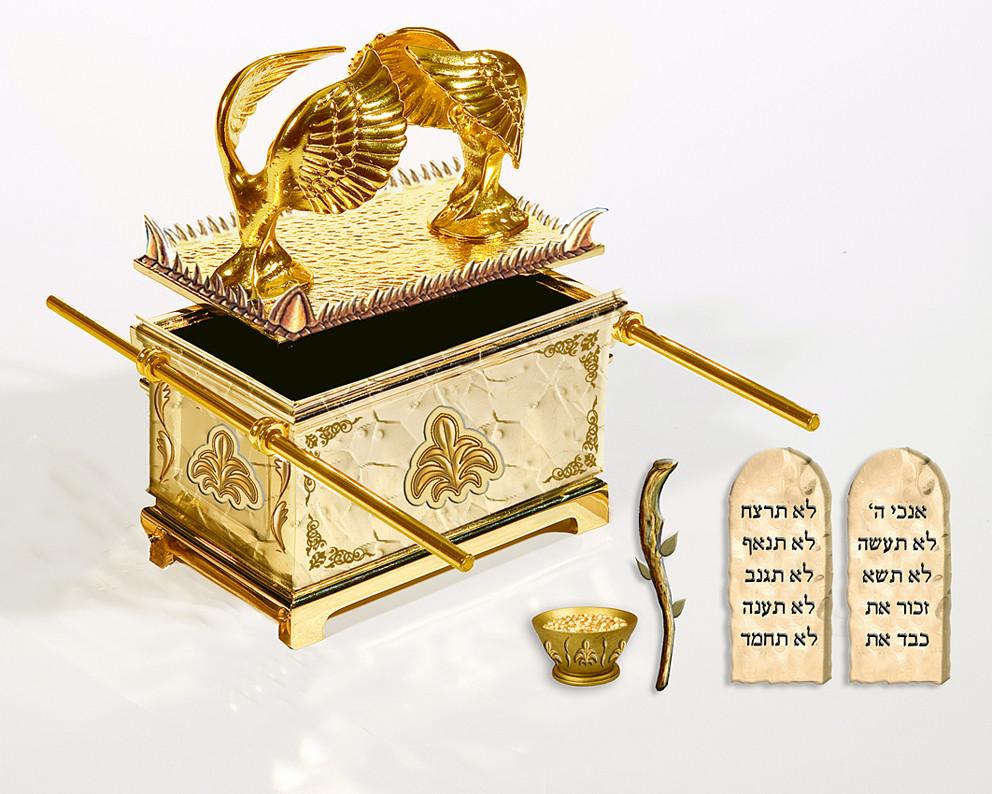
Inside the Holiest of All was the ark of the covenant; approximately 4 feet long, 2 feet wide and 2 feet high, covered in gold; the ark of the covenant had rings attached so that poles could be used to carry it since nobody could physically touch the ark for fear of dying. Inside the ark was a golden pot that had manna, Aaron's rod, and the tablets of the covenant. Once a year, during the Day of Atonement (Yom Kippur) the High Priest would go into this holiest of all and sprinkle blood of the sacrifice on the ark.

Image of replica Ark of the Covenant (from "Holy Land Gifts")

Think about the tabernacle. Now think about your church. Are there design similarities that have been carried through the ages?

The author then goes on to talk of the role of a tabernacle priest. They are to worship every day in the first room (which included tending the lampstand and replacing the bread with fresh loaves), but only once a year go into the Holiest of All. When they went into the Holiest of All, they had a rope tied around their waist (so if they died in there, they could be pulled out), they had bells on (so people could hear them moving, if the bells stopped making noise it was assumed that they were dead) and they had blood to sprinkle on the Ark for the Atonement of Israel. Access to God was severely limited and it wasn't for fellowship- it was for the atonement of sin. There was usually a large celebration when the high priest came out of the holiest of holy place, as he had been in the presence of God and survived.  What does that say about the feeling toward God?

"But..." (v 11); I like these transitions. It is saying what we just talked about might have been good, however, I have something different (translated as better) that we need to talk about! The "more perfect tent" (v 11a) was Christ's body and it replaced the tabernacle/temple. And it wasn't made by people- it was made by God- so tat made it better than the original! The sacrifice that Christ made on the cross was the day Christ entered the holiest of holy places and used Christ's blood (not lamb, or goat, or cow blood) to "pay" for our atonement (v 12). The blood of Christ does so much more for us than does the blood of animals or ashes (vv 13-14). How much better is our life knowing that we have eternal forgiveness, not just periodic and temporary (remember, the high priest had to go in every year and renew the forgiveness)?

People sometimes ask why died Jesus have to die. The author answers this question in vv 16-17. In order for a will to be enacted (some translations use the word "testament" as in last will and testament), the person who writes the will has to die; for God to give us eternal forgiveness and salvation, God had to die- through Jesus the Christ. If Jesus didn't die- there would have been no Gospels; no covenant, no life as we know it. Clearly, death was necessary to the Old Covenant (vv 18- 22). Virtually every part of the sacrificial system under the Law of Moses was touched by blood in some way or another. There needs to be shedding of blood for the remission of sins. Modern people think that sin is remitted (forgiven) by time, by our good works, by our decent lives, or by simply death. But there is no forgiveness without the shedding of blood, and there is no perfect forgiveness without a perfect sacrifice. The shedding of Jesus' blood was God's answer to human sin. The perfect sanctuary (Christ) received and provided a perfect sacrifice. 

The closing verses solidify all that has been said in this section. The tabernacle was the "copy" of heaven and it was run by imperfect people with imperfect sacrifices...but that was appropriate since it was only a copy. Once the real "tabernacle" came (Jesus), there needed to be a "real" sacrifice- Jesus' death on the cross was needed to fulfill the realness of God's covenant with humans. The real sacrifice had to happen only once (not yearly as in the past). 

The final promise (v 28b) that the author reminds of is that Christ will come again- not for sacrifice but for our rescue from this world. How does that feel to you?

Some tough concepts but I think easier then the others. Chapter 10 is a continuation of this argument that the author is making (with many things repeated). Again, remember the point of Hebrews- written to Jews that were following Christ that had become disillusioned and are returning to Judaism. The author is arguing that Jesus is a much better offer than their "old" religion. 

Enjoy the day! Be at peace.

Shalom+
Pastor Paul

A Final Post

 Good morning. We did it! The entire New Testament in a year. that is quite a feat! Thank you all for your dedication and work. It wasn'...